












frange
home research publications projects cv
bandeau
where email ORCID

91 Publications:

2013..

14

7

..2026

750 Citations*:

2015..

167

84

..2026

h = 16 / i10 = 22

102 Co-Authors:

Alibart F. (41)
Coffinier Y. (32)
Guérin D. (25)
Scholaert C. (19)
Ghazal M. (18)
Lmimouni K. (17)
Baron A. (16)
Janzakova K. (16)
Vuillaume D. (13)
Kumar A. (12)
Halliez S. (11)
Schmid G. (11)
Hafsi B. (9)
Dargent T. (9)
Hernández-Balaguera E. (8)
Colin M. (7)
Buée L. (7)
Susloparova A. (7)
Moustiez P. (6)
Ferchichi K. (6)
Bourguiga R. (6)
Maltenberger A. (6)
Routier L. (5)
Boujnah A. (5)
Boubaker A. (5)
Kalboussi A. (5)
Daher Mansour M. (5)
Lefebvre C. (4)
Janel S. (4)
Barois N. (4)
Kessler F. (4)
Toledo Nauto M. (3)
Balafrej I. (3)
Rouat J. (3)
Westrelin A. (3)
Cerveaux A. (3)
Foulon P. (3)
Louis G. (3)
Horlac'h T. (3)
Yger P. (3)
Lončarić I. (3)
Zlatić V. (3)
Crljen Ž. (3)
Lenfant S. (3)
Regensburger S. (3)
Halik M. (3)
Bonetti S. (3)
Borrachero Conejo A. I. (3)
Generali G. (3)
Muccini M. (3)
Toffanin S. (3)
Benfenati V. (3)
Drouin D. (2)
Haj Ammar W. (2)
Garg N. (2)
Çağatay Tarhan M. (2)
Pentlehner D. (2)
Karges S. (2)
Pistone A. (2)
Quiroga S. D. (2)
Natali M. (2)
Grishin I. (2)
Caprini M. (2)
Wemken J. H. (2)
Bisquert J. (1)
Viala A. (1)
Delarue M. (1)
>> Kingoum Taka A. (1)
Brulin L. (1)
Kenne Koudjou S. (1)
Le Cacher de Bonneville B. (1)
Kanso H. (1)
Gourdel M.-E. (1)
Reverdy C. (1)
Gasse C. (1)
Saadi P.-L. (1)
Rain J.-C. (1)
Vercoutere E. (1)
Kenne S. (1)
Morchain C. (1)
Dumortier C. (1)
Ghodhbane N. (1)
Melot A. (1)
Oumekloul Z. (1)
de Maistre A. (1)
Pernod P. (1)
Talbi A. (1)
Pallecchi E. (1)
Begard S. (1)
Thomy V. (1)
Arscott S. (1)
Athanasiou V. (1)
Konkoli Z. (1)
Przyczyna D. (1)
Szaciłowski K. (1)
Mastropasqua Talamo M. (1)
Blanchard P. (1)

1 Years [Kingoum Taka A.]:

2026 (1)
2025
2024
2023
2022
2021
2020
2019
2018
2017
2016
2015
2014
2013

A' B' O' P' T'
1 w/ Aymar Kingoum Taka
[A36] Exploiting the Mixed Conduction of a Doped Conjugated Polyelectrolyte on an Electronic Nose Circuit Board | Discov. Electron. 3(1), 105 (2026) [IF = --; 1 cit.] bib hal

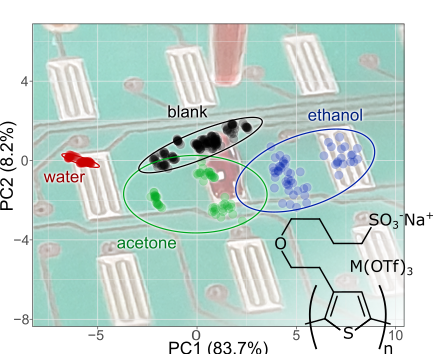
Abstract: Machine olfaction is still not embedded in portable devices. Relationships between electronic materials and chemical environments are hard to decipher to build phenomenologic models that formalize smells' and odors' subjectivity. Also, machine olfaction requires norms to generate large datasets: a generic technology, easy to manufacture and integrable to the broadest range of electronic devices must be identified. To this aim, this study reports on relevant materials to be processed on cost-effective el ectronic noses. Using a single water soluble conducting polymer but sensitized with various p-dopants deposited directly on the circuit board, solvent vapors are successfully recognized on a USB-powered small-sized prototype. The chosen doped polymers ar e easy and safe to process, particularly sensitive to water, but successfully discriminate moist from acetone and ethanol vapors. Diversifying the nature of the doping metal salts increases the prototype receptive field and allows better identification o f the nature of volatile chemical compounds. This study contributes to identifying relevant materials to be processed in an easy way on electronic circuits to implement machine olfaction in portable IoT systems, by the use of various mildly doped conduct ing polymers. By its statistical approach, this study also raises several hypotheses on the physical origin of the sensitivity of a specific class of polymers which transport both electrons and ions. The development of such cost-effective platform allows effectively to compare the performances of multiple materials in a reproducible and systematical way, to ease multi-material performance screening supported by multivariate data analysis.

2026

Kenne Koudjou S., Delarue M., Kingoum Taka A., Baron A., Hafsi B., Pecqueur S.*

© 2019-2026 Sébastien Pecqueur