
















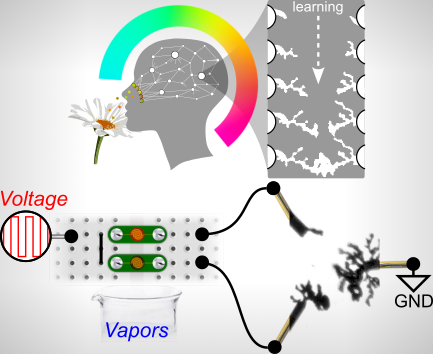
 Abstract: If electronics drives only electrons to charge electrodes, natural systems learn by moving matter to evolve. Morphogenesis in sessile organisms can be seen both as a fabrication process and as an operative mechanism. However, intricating manufacturing an d programming functionalities in electronic hardware is not conventional. In this study, we experimentally implement such a concept of an evolutionary electrical system using a neuro-inspired electronic nose as a model, to store a history of sensory data in the physical properties of the electrical interconnects of sensing elements. Triggered only by volatile molecule exposures, different sensing elements change instantaneously and reversibly their impedance, so pulse voltages enable the electrochemical growth of conducting polymer dendrites. The strength of the evolving interconnects is specific to the sensing materials and to the nature of volatile molecules to which they are exposed. The dendritic growths occur exclusively when exposed to volatile s amples, and stop immediately after interrupting the exposure. The capability of such "passive memory" was also assessed by simulating a network architecture, which showed that this way of storing information should greatly diminish the fabrication comple xity of a highly dense sensing array while realistically enabling its calibration to classify user-specific environment exposures. By demonstrating that memory in electronics can be a concept linked to manufacturing like in living organisms, this study s hows that low material resources and low voltage fabrication processes based on electrochemistry can be exploited for practical electronic applications in future-emerging sensing technologies.
Baron A., Hafsi B., Hernández-Balaguera E., Pecqueur S.*
Abstract: The brain exploits electrochemistry both to process chemical information and to fabricate itself: two functionalities that silicon cannot achieve by itself. In a complementary approach, this presentation reports on a few elements suggesting that electrop olymerization on a chip is a way to gather sufficiently rich chemistries on a miniaturized electronic nose, and that "letting" sensors connect during an application could be a solution for electronics to self-manufacture, reducing its environmental footp rint, while unlocking unprecedented computing functionalities beyond charging and discharging memory cells. By controlling the electrochemical growth of conducting polymers on micro-electrode arrays in a microliter sized droplet, conducting polymers with various chemistries can be confined additively at a micrometer scale on conductimetric devices. Since conducting polymers are both macromolecular materials and doped semiconductors, they intrinsically feature both chemical detection and electrical trans duction, like G-coupled proteins on olfactory receptor neurons, to generate relevant information on a sugar-cube sized electronic nose. Electropolymerization allows growing films on devices, but also interconnecting them with an incredibly versatile way. Branching out from electrodes, conducting polymer dendrites grow by the action of voltage pulses. The temporality of the voltage and the chemistry of their growth medium allow them to form various sizes and shapes, which program their equivalent circuit deeply through their structural evolution. Because polymers can drive both electrons and ions, their fractal structure relates to diffusion-limited capacitive decays, offering a second degree of freedom, unexploited in analog electronics, to program the fading memory time window of a dendritic junction between neighboring devices. By embedding such bio-inspired functionalities as neurogenesis and morphogenesis into electronics, conducting polymers electrochemistry could greatly contribute in fabricatin g electronic chips in a more sustainable manner while unlocking new programming functionalities to generate and process information.
Pecqueur S., Baron A., Viala A., Moustiez P., Guérin D., Dargent T., Hernández-Balaguera E.
Abstract: Understanding the electrical mechanisms underlying artificial synaptic plasticity is essential for neuromorphic engineering. This work presents a unified electrical perspective connecting the simple bioelectrochemical dendrites and the greater complexity of memristors as complementary platforms for studying memory effects in artificial brain-inspired synapses. First, we show how conducting polymer dendrites exhibit fractional-order transient responses arising from coupled ionic and electrochemical proce sses, reproducing key features of synaptic plasticity such as history-dependent dynamics and synaptic learning behavior during morphogenesis. Similar electrical signatures are observed in halide perovskite memristors, where ion migration and charge accum ulation govern conductance modulation and short-/long-term potentiation. By combining Impedance Spectroscopy and transient analysis, we explain the electrical tools for quantifying the physics-based memory effects across biology and neuromorphic engineer ing. This electrical approach bridges bioelectrochemistry and neuromorphic hardware, offering new insights into the physical origins of synaptic functionality while providing practical guidance for the design and interpretation of next-generation brain-i nspired electronic systems.
Hernández-Balaguera E., Baron A., Pecqueur S., Bisquert J.
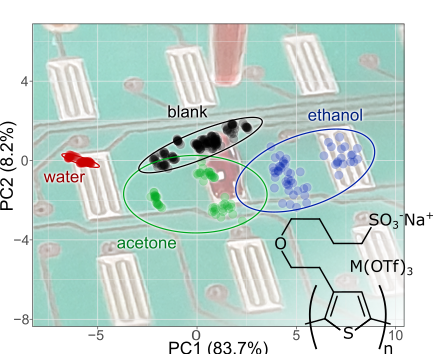 Abstract: Machine olfaction is still not embedded in portable devices. Relationships between electronic materials and chemical environments are hard to decipher to build phenomenologic models that formalize smells' and odors' subjectivity. Also, machine olfaction requires norms to generate large datasets: a generic technology, easy to manufacture and integrable to the broadest range of electronic devices must be identified. To this aim, this study reports on relevant materials to be processed on cost-effective el ectronic noses. Using a single water soluble conducting polymer but sensitized with various p-dopants deposited directly on the circuit board, solvent vapors are successfully recognized on a USB-powered small-sized prototype. The chosen doped polymers ar e easy and safe to process, particularly sensitive to water, but successfully discriminate moist from acetone and ethanol vapors. Diversifying the nature of the doping metal salts increases the prototype receptive field and allows better identification o f the nature of volatile chemical compounds. This study contributes to identifying relevant materials to be processed in an easy way on electronic circuits to implement machine olfaction in portable IoT systems, by the use of various mildly doped conduct ing polymers. By its statistical approach, this study also raises several hypotheses on the physical origin of the sensitivity of a specific class of polymers which transport both electrons and ions. The development of such cost-effective platform allows effectively to compare the performances of multiple materials in a reproducible and systematical way, to ease multi-material performance screening supported by multivariate data analysis.
Kenne Koudjou S., Delarue M., Kingoum Taka A., Baron A., Hafsi B., Pecqueur S.*
 Abstract: While human technology is ruled by determinism, biological systems exploit a subtle balance of control and stochasticity. This balance, evident in the morphogenesis of textural patterns imprinted on leaves, fur or skin can help hierarchize organisms both as a representative of their species and as unique individuals. In this study, we identified that, by exploiting electrochemistry, it is possible to generate such versatile but specific textures, to imprint patterns of a conducting polymer on a conducti ng substrate. It is shown that the 1D morphogenesis of conducting polymer dendrites on wires translates, on 2D surfaces, as highly heterogeneous coatings of dark spots, rosettes or marbled patterns. Despite their inherent stochasticity, these patterns ar e characteristic of the physical conditions they grew in, and particularly of the chemical content of the electroactive solution used for their electropolymerization. A statistical study demonstrates that these patterns could be used as fingerprints to p hysically tag the identity of a solution within a specific class. By the identification of a new electrochemical process which allows generating physical fingerprints with optical, electrical and chemical contrast on an electrode, this research paves the way toward a disruptive low-cost technology which could allow any end-user to generate personal tags on a glass slide or on a micro-chip, to engrave physically-encrypted personal information for various applications.
Baron A., Brulin L., Scholaert C., Coffinier Y., Alibart F., Pecqueur S.*
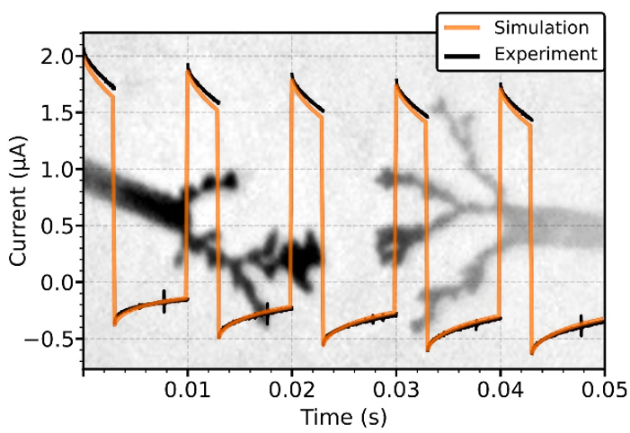 Abstract: Understanding and reproducing the brain's ability to store and process information remains a central challenge in neuromorphic engineering. Here, we identify the physical origin and provide a phenomenological interpretation of memory effects underlying s ynaptic-like plasticity, realized in brain-inspired electrochemical dendrites, from fractional calculus. Using hybrid ion-electron conduction pathways, such artificial dendrites exhibit anomalous transient responses arising from the complex dynamics of i onic diffusion and electronic transport across the nanostructured interfaces, effectively embedding history-dependent behavior in the electrochemical junctions. These insights show that the constant phase element (CPE) is more than a simple fitting const ruct used commonly in Electrochemistry: It provides a fundamental description of multiscale transients, capturing the complex dynamical behavior associated with memory effects and their analogy to synaptic functionality. Beyond the classical Mittag-Leffl er responses obtained under previous equilibrium conditions, the hereditary behavior behind artificial synaptic activity emerges as fractional-order dynamics with cumulative Mittag-Leffler patterns in the current responses, offering a natural platform fo r understanding device-level short- and long-term potentiation effects. Our approach, faithfully captured by a quantitative physical model validated through experiments and simulations, encodes past-state memory in neuromorphic devices, bridging physical processes and system-level modeling while enabling dendrite-inspired circuits capable of learning and temporal information processing.
Baron A.*, Pecqueur S., Hernández-Balaguera E.*
© 2019-2026 Sébastien Pecqueur