

















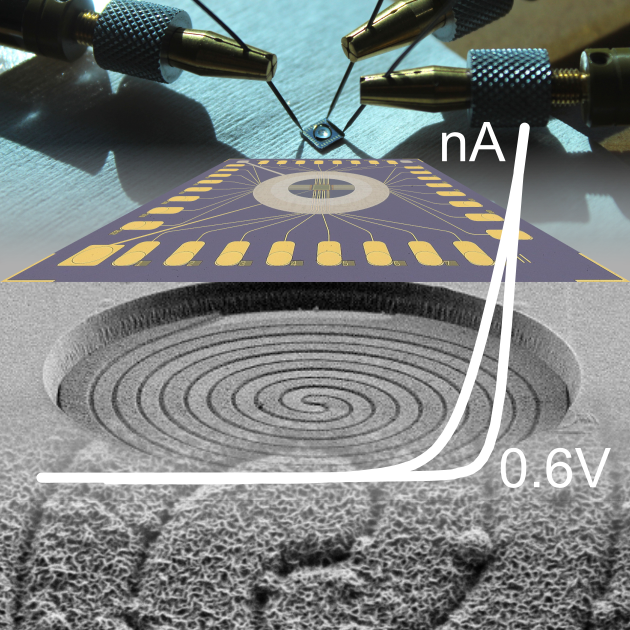
 Abstract: Fabricating electronic devices spoiling the least resources is of an increasingly high importance. Also, micro-electronics hardly embeds chemical functionalities on silicon, as soft materials suffer from harsh conditions of conventional processes. In thi s study, electrochemistry on a chip is investigated to pattern conductivity-based measurement devices at small scale via electropolymerization. To comply with additive manufacturing, a dewetting coating and local quasi-reference/counter micro-electrodes shall be integrated on each chip. The process reliability is challenged using minimalist chemical and energy resources, such that a microliter droplet of an electro-active solution composed mostly of a non-toxic and affordable solvent suffices to coat 16 elements on a 3x3 mm2 chip. Despite the complexity of electrochemistry at such scales, the coatings variability is dominated by the chemical composition of the droplet. Avoiding a vessel to confine large volumes of solutions and integrating all electrod es is required to reduce drastically the electrochemical signal noise. This demonstrates its sufficient stability to screen conducting polymer materials when their precursors are not available in large amount to be coated with conventional techniques. It also demonstrates its compliance for chips microfabrication using conducting polymers as functional materials for electrochemically-assisted additive manufacturing production.
Moustiez P., Guérin D., Pecqueur S.*
Abstract: Electropolymerization under an alternating-current results in the formation of conducting polymers dendrites (CPDs), that conduct both ionic matter and electronic charges simultaneously, offering features from both the worlds of electronics and electroch emistry. Versatile, they can be grown in various electrolytes to develop classes of electronic components that are evolvable and process information using mass-transfer mechanisms. By self-healing or resorbing, CPD have the potential to enable new functi onalities in conventional electronic systems with low material and energy costs, making them a promising avenue for bio-inspired information processing. They also offer a simple, low-voltage alternative to address the ongoing problem of high manufacturin g costs in the microelectronics industry. In this work, we investigate the control of poly(3,4-ethylenedioxythiophene) (PEDOT) based CPD morphology through electrolyte chemistry and its impact on impedance patterns in a two-electrode system, particularly in relation to their observed constant phase element (CPE) behavior. We also explore how morphology influences the charge/discharge dynamics when the dendritic connection is not yet completed. Specifically, it is shown that the electrical parameters of the CPDs, extracted by fitting the transient curves using the Mittag-Leffler function, are defined early during the growth, and that thicker CPDs will allow longer relaxation times. By changing the voltage pulse duration in the growth signal, one has the refore the ability to tune both the characteristic times and the non-ideality of a CPD charge. Ultimately, we aim to demonstrate the applicability of these concepts for programming sensors and integrating neuro-inspired functionalities into electronic no ses, which exploit electrochemistry for the recognition of complex environmental patterns.
Baron A., Scholaert C., Hernández-Balaguera E., Guérin D., Moustiez P., Coffinier Y., Alibart F., Pecqueur S.
Abstract: Conducting polymers are used in conductimetric transducers for many sensing technologies. On arrays, sensitive surfaces feature a large variety of materials: A clean process must be used to co-integrate them without threatening each material's integrity. As electrochemical technique, electropolymerization coats electrically-conductive materials with specific chemistries only on polarized electrodes without contaminating all others. As bottom-up deposition technique, it can be used to coat high-density a rrays at scales that are compatible with micro-electronics. The last decade has also shown the emergence of highly miniaturized potentiostat-galvanostat-impedance platforms, featuring all the necessary resources to communicate with external systems. Ther efore, material electrodeposition and impedimetric readout could practically be performed at very small dimensions and concomitantly on the same circuit board. Here, we present preliminary results on the use of miniaturized impedance analyzers and potent iostats to electropolymerize conducting polymers on a circuit board and to exploit electropolymerized coatings on arrays of microsensors, integrated into a miniaturized prototype. In a loop where a single circuit can supervise both its own manufacturing and its own environmental analysis, the study aims at paving the way for IoT objects embedding electrochemistry and machine-learning resources to support autonomously multi-material selections for electronic noses and tongues conception, directly on a bo ard.
Routier L., Toledo Nauto M., Guérin D., Moustiez P., Baron A., Lmimouni K., Coffinier Y., Hafsi B., Pecqueur S.
Abstract: In the recent challenge to decentralize microelectronics manufacturing (Eur Chip Act) while keeping our commitment to lower our environmental footprint (Eur Green Deal), processes to manufacture electronics must be additive and personalized. To this aim, electropolymerization on a chip could be a turning point to reinvent semiconductor deposition, not exploiting precious ores but synthetic precursors, additively with low wastes and energy consumption at manufacture, in ambient using electrochemistry. If electropolymerization is mastered on large-sized electrodes (mm2), materials behave however far differently at the micrometer scale, where isolated electropolymerized particles with large surface-over-volume ratio are destabilized, from electrode coatin gs to colloidal suspensions in the electrolyte. In this study, we investigate on structure-property relationships between the composition of an electrolyte (electroactive oligothiophenes solubilized in low volatility and toxicity solvents), the arrangeme nt of co-integrated quasi-reference (Ag) and counter (Pt/Au) microelectrodes to stabilize conducting polymer coatings locally on each working microelectrodes in an array of sensing elements. The coatings' electrical and morphological properties are highl y depending on the electrolytes and the set of monomers co-deposited at the same voltage. Important selections have to be made in regards to monomers' oxidation potential, their solubility in specific solvents and polymers' electroactivity, which control s both the electrical property of the sensors and the stability of the material in an iterative deposition process. By mastering electropolymerization on a chip, electrochemistry shall unlock a true bottleneck for multi-material co-integration to manufac ture highly integrated electronic noses and tongues.
Moustiez P., Guérin D., Baron A., Pecqueur S.
Abstract: Contributions of organic semiconducting materials to electronics are particularly hard to assess: As macromolecular organizations, they have low enthalpy so they can be processed in soft conditions and they have resilience to deformation. However, for th e same reason, they have also broader density of energy states and more instabilities than silicon in ambient. Controlling matter's order at low scale and its properties for as long as possible were always golden standards for microelectronics. Neverthel ess, in a time where brain functioning rises even more as a source of inspiration, shall it still be so? Here are presented clues on how physical property dispersions may be relevant features for information generator nodes to recognize patterns. In a co ntext where the information to recognize is not trivial to physically define, no model can rule sensors' classification a priori. Despite this, broadening the conducting polymer temporal responses in a sensing array allows recognizing dynamical voltage p atterns, or broadening conducting polymer's chemistry in a sensing array enlarges a classifier's perception field to recognize solvent vapors in air. By the nature of property dispersions in regards to the information to recognize, physical variabilities (structural and chemical) can be assets to exploit for pattern recognition and not necessarily drawbacks to bypass for hardware manufacturing. The brain architecture is also transient: a part of the processed information is engraved in its topology, sho wing that a hardware classifier can make use of physical instabilities as part of its programing, by forming new connections in a nodal architecture. Some evidences are also presented here, on how dendritic morphogenesis of a conducting polymer can be a mean to store past voltage experiences in the impedance between nodes in a topology. Very distinct electrochemical features appear in the readout impedance information after growth and these features are to be associated with the shape of a voltage wave inputted on the junction. By the physical implementation of materials' disorder and transience in electronics devices, it is expected that organic semiconductors will integrate essential ingredients in future-emerging information generator nodes beyond s ensors: from embedded random information generating resources to evolving abilities in information classification architectures.
Pecqueur S., Baron A., Scholaert C., Toledo Nauto M., Moustiez P., Routier L., Guérin D., Lmimouni K., Coffinier Y., Hafsi B., Alibart F.
© 2019-2026 Sébastien Pecqueur